.svg)
.svg)


.svg)

Both Pipedrive and HubSpot updated their pricing in 2025, and both CRMs doubled down on new features. Especially in AI, workflow automation and data enrichment.
This 2025 comparison walks through real differences between Pipedrive and HubSpot, practical pricing, core features, AI capabilities and who each platform is best for.
If you’re trying to decide which CRM is better for your team in 2025, this breakdown will help you choose with confidence.

Pipedrive: What's New in 2025
Pipedrive introduced several major updates in 2025 that made it a much stronger sales CRM.
Just like the rest of the industry, most updates revolved around AI, automation and data quality.
Some of the biggest upgrades include:
- Pulse, the new dashboard for managing leads and deals
- Sequences for deals and leads (major upgrade for scaling cold outreach)
- Data enrichment 2.0 with more accurate company/person data
- Column filtering across all list views, similar to Google Sheets
- AI Assistant with access to live Pipedrive data
- AI Reporting — instant report generation
- Deep integrations with Apollo, Lemlist, Surfe and PandaDoc
- Deal card customization for cleaner pipeline visibility
- If/else branching in workflow automations
- Changeable workflow triggers for easier cloning
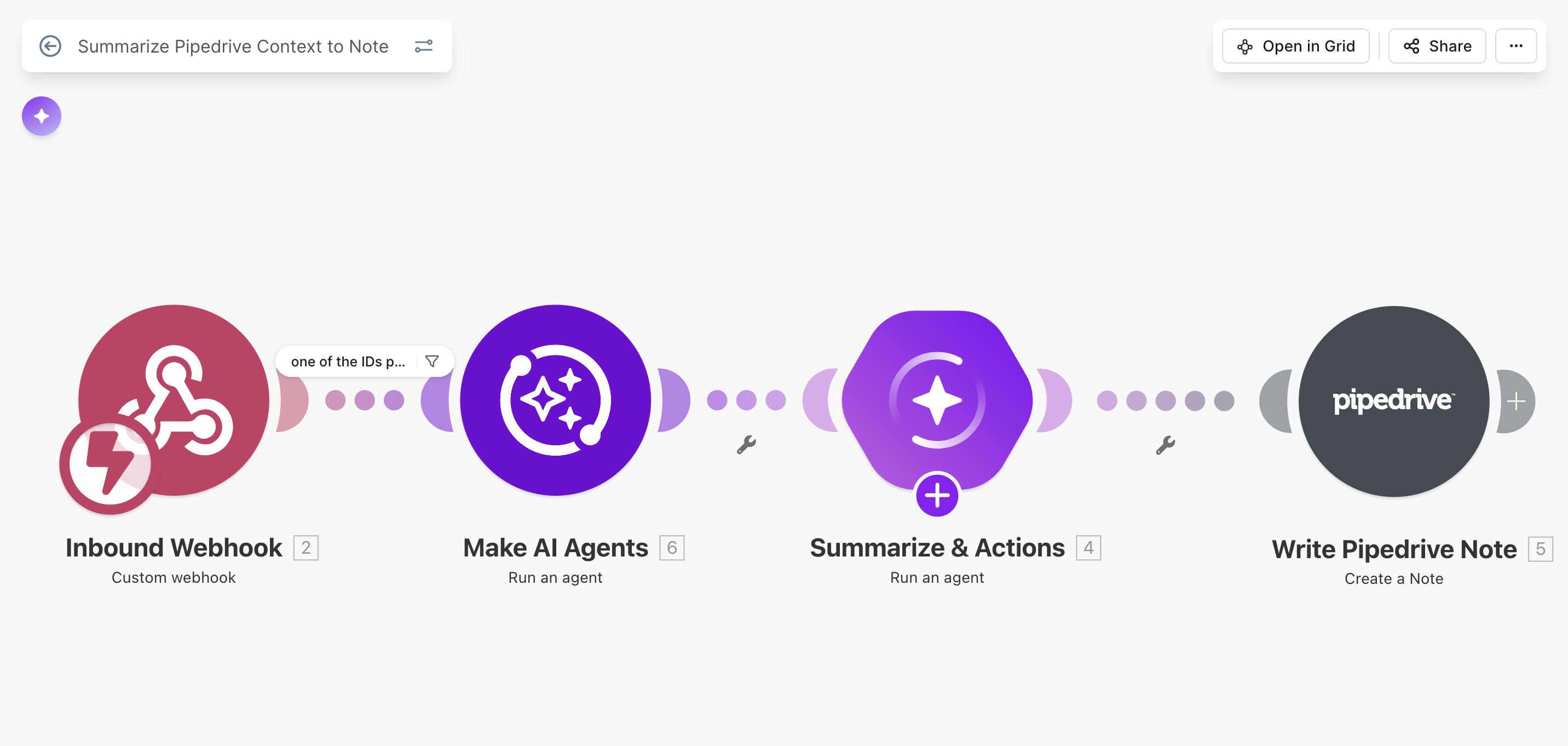
- Webhook actions inside workflows (HubSpot charges $700/mo for this)
Pipedrive focused on making sales workflows easier, faster and more scalable — and nailed it.
Pipedrive Pricing in 2025
Pipedrive renamed and restructured its pricing tiers in 2025. The pricing remains transparent and still one of the cleanest structures in the CRM industry.
2025 Pricing Tiers
- Lite — $14/mo
Basic entry-level tier with limited features (lock-in tier). - Growth — $39/mo
The tier where most serious users start. Great value. - Premium — $59/mo
Includes SmartDocs, LeadInbox, Projects. Best value overall. - Ultimate — $79/mo
Everything Pipedrive offers + enrichment + partner discounts.
Pipedrive remains one of the most reasonably priced CRMs, especially with the 2025 AI improvements.
[CTA title="Get an Extended 30‑Day Pipedrive Trial" body="Test every feature of Pipedrive with a full 30‑day extended trial — including AI tools, automations, pipeline management and all premium features." btn_text="Start Free 30‑Day Trial" btn_link="https://app.pipedrive.com/affiliate/pdp-MWS" gradient="true"]
Real Monthly Cost of Pipedrive (2025)
The CRM is true to its core mission, which in some regards is limiting (i.e. the Campaigns Add-On still isn't great — even though our love for Pipedrive remains unshattered).
Pipedrive does not compromise on sales functionality: deals are solid, leads have been upgraded significantly, workflows remain intentionally simple yet extremely powerful thanks to major updates this year — including webhook actions, changeable triggers and if/else branching.
Here's a simple rule of thumb for calculating monthly cost:
- $60/mo per user. At $80/mo per user you get all features, including email and phone enrichment (though still not as strong as tools like Apollo or Surfe).
- + $20–40/mo total (no additional seats needed) for Make.com. This tool is essential — we use it in every Pipedrive project. Make closes the gap between Pipedrive and advanced integrations with external apps.
- + email marketing or cold outreach tool of your choice — typically $50–80/mo per user.
A complete setup for 5 users costs approximately $570/mo.
Still significantly cheaper than HubSpot.
Who Pipedrive Is Ideal For in 2025
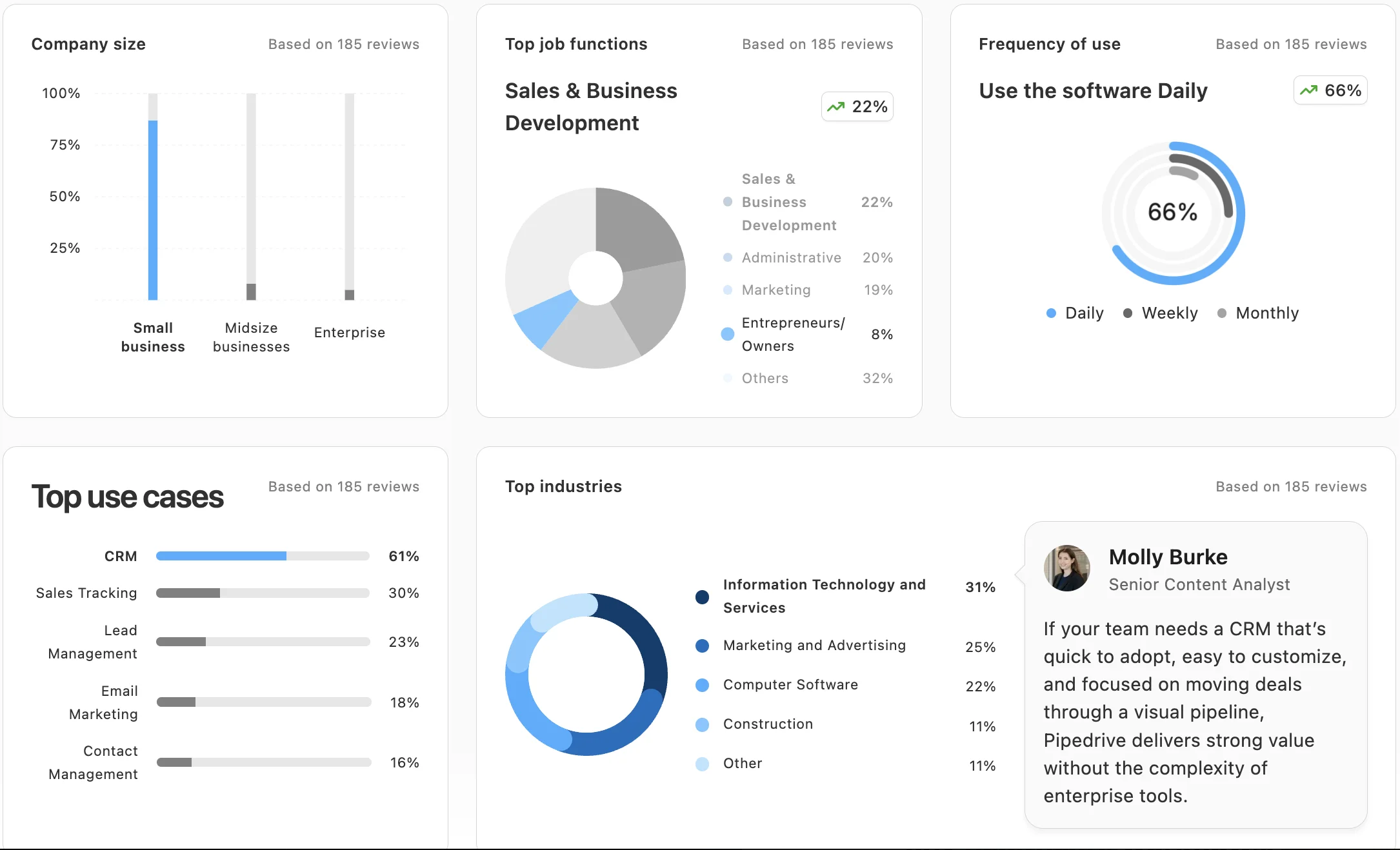
Pipedrive's core audience hasn't changed: it's still perfect for small and mid-sized businesses focused on sales, especially email-based outbound.
If your priorities are simplicity, speed and clean workflows, Pipedrive is one of the strongest options on the market.
Non-obvious Pipedrive advantages over HubSpot
- Built-in caller uses your real phone — you can call directly from desktop without buying any extra VoIP tools. It works instantly and is extremely convenient for sales teams.
- Webhooks inside workflows — a feature HubSpot charges around $700/mo for. In today's API-driven environment, this gives Pipedrive a major advantage.
- Sequences behave like real email threads, using your regular email client. HubSpot only unlocks comparable sequences in higher Sales Pro tiers (starting at $100/user).
- Batch emails, batch tasks and batch updates are far more intuitive and accessible than in HubSpot. HubSpot still lacks proper batch emailing entirely.
- A proper email inbox — still missing in HubSpot. In Pipedrive, emails are displayed cleanly and in full context within the deal or contact.
- A proper calendar and activity screen — HubSpot's meetings and tasks remain scattered, making daily sales workflows slower and less organized.
- Free transactional emails in workflows — HubSpot charges around €600/mo for this functionality. In Pipedrive, it's included by default and works extremely well for automated follow-ups.
Pipedrive is built for sales execution — clean, fast and powerful.
HubSpot: What's New in 2025
HubSpot exploded with features in 2025 — so many that the company introduced a dedicated Product Updates section to track all new releases, betas and upcoming features.
This was one of HubSpot's biggest release years ever, with improvements across sales, marketing, reporting and automation.
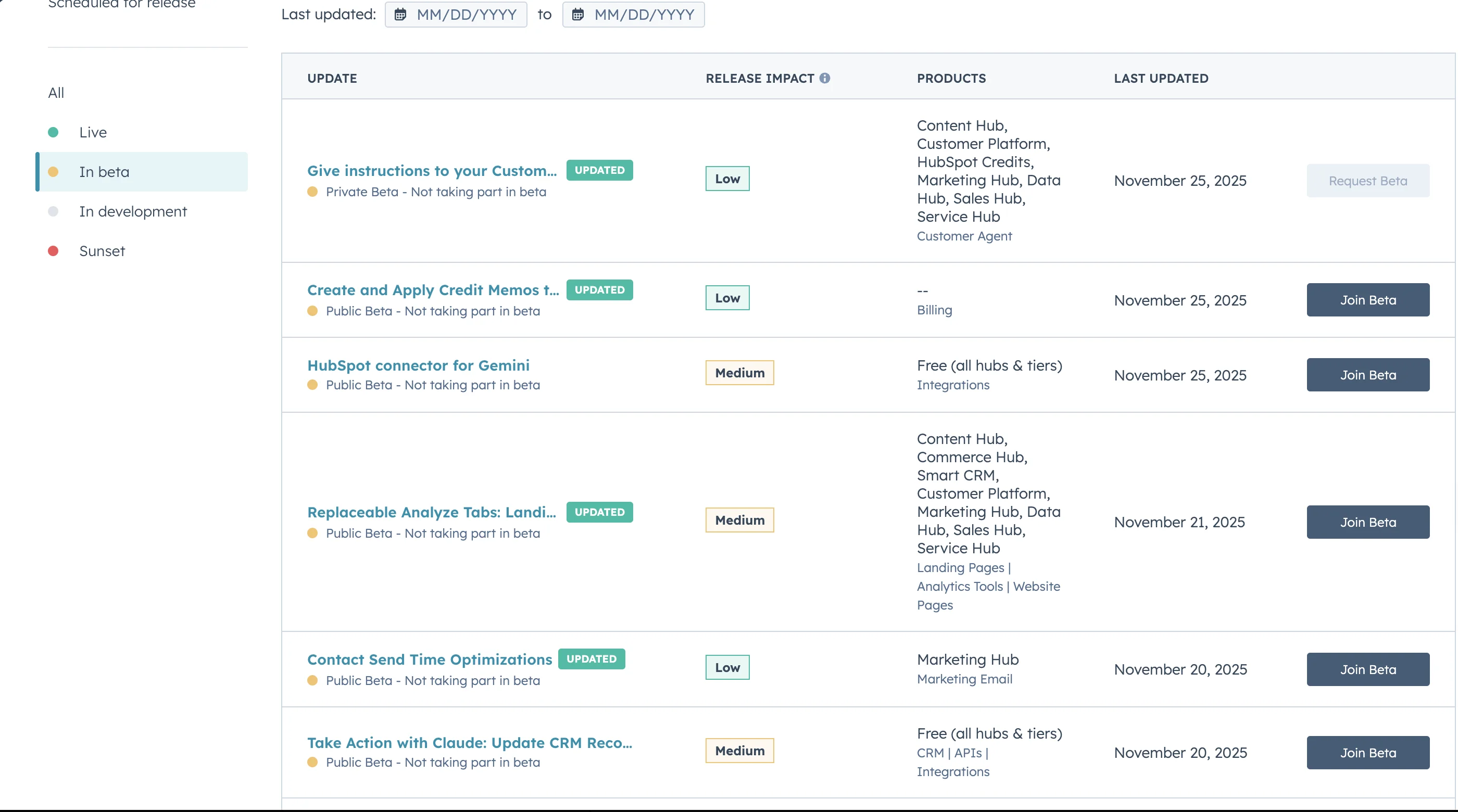
Our favorite updates in 2025 include:
- Sales Dashboards with a calendar (something Pipedrive had since Day 1, but weirdly absent in HubSpot). That calendar finally shows your meetings in HubSpot. It sounds like a regular feature, but it's a breakthrough in the HubSpot world.
- Breeze — a suite of AI tools, including a chatbot with access to HubSpot data, an AI workflow builder, report builder, “everything builder” and — our favorite — an AI description writer for almost everything.
- Projects as a separate entity, making HubSpot an incredibly flexible project management tool. For new users, Projects might even be a reason to skip an additional project management app.
- Tailored custom objects for different industries, making it easier to track additional entities without investing in the Enterprise tier that unlocks general custom objects:
- Appointments
- Marketing Events
- Listings
- Services
- Massive updates to the workflow engine, supporting meeting triggers, task triggers, association label updates, a more streamlined UI and better testing capabilities.
These upgrades now put HubSpot above Salesforce in UX and automation flexibility.
HubSpot Pricing in 2025 (Real Costs Explained)
As of December 2025, HubSpot has made a few pricing adjustments, but the platform still remains one of the most expensive CRMs on the market. HubSpot pricing in 2025 is still complex, bundle-based and heavily discount-dependent. Your final monthly cost depends on marketing contacts, user seats, connected domains, hub tiers, add-ons, and often even requires a call with HubSpot's sales team.
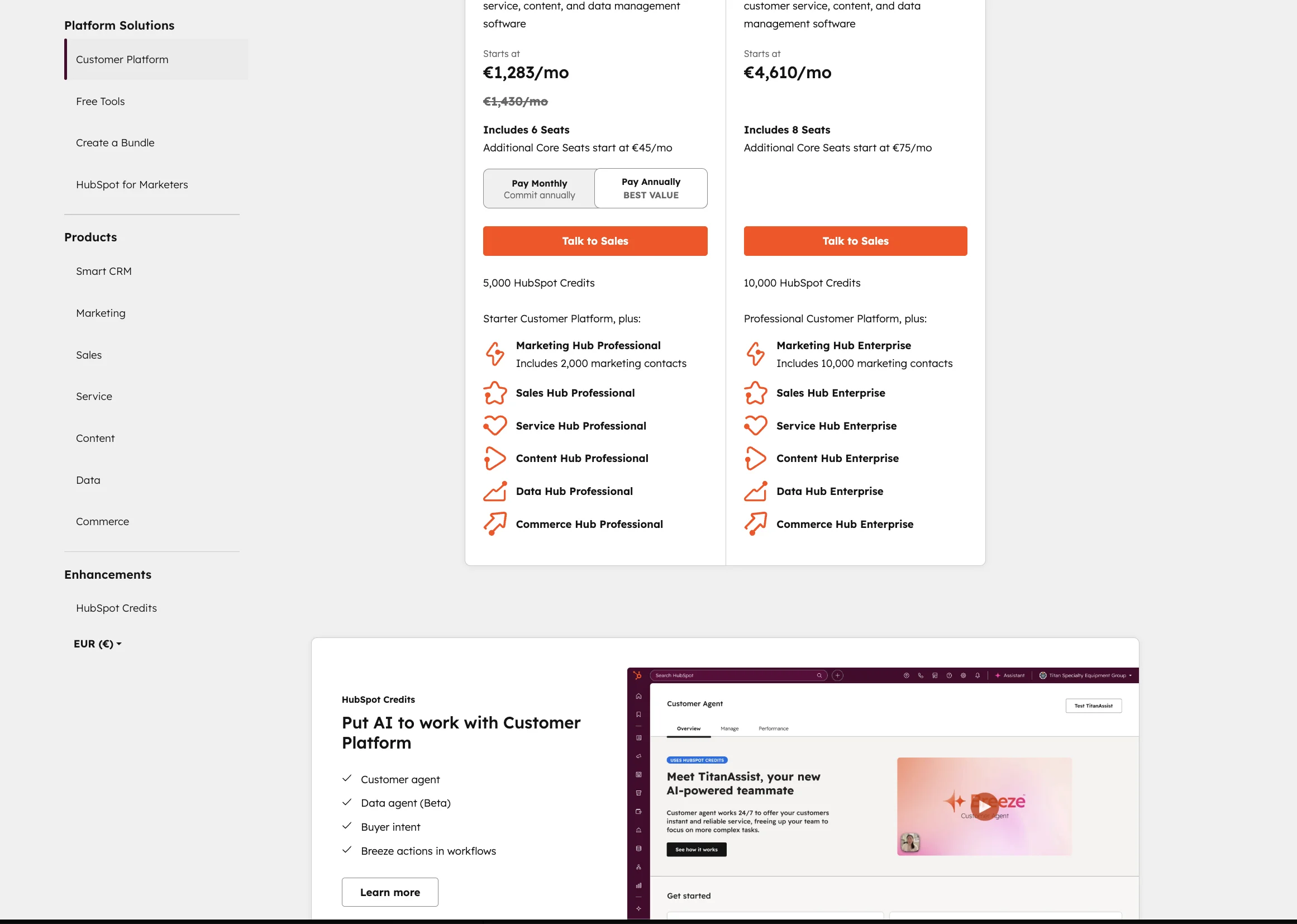
Here's the real HubSpot cost breakdown in 2025:
- HubSpot is ~3× more expensive than Pipedrive, with “unlocked” features starting at $1,200+ per month.
- Free and Startup tiers act as lock-in tiers. Startup discounts expire after 12–24 months, and pricing can increase by roughly 90%.
- Bundles reduce the cost, but even with 20–30% bundle discounts, most setups still fall in the $2,000–$3,000 per month range.
- Teams of 5–10 users typically spend $35K–50K+ per year, depending on hubs, add-ons and the number of marketing contacts.
- For deeper automation and integrations, companies still rely on Make.com, Zapier or n8n, since HubSpot's native automation has limitations at lower tiers.
- Eligible startups can secure significant discounts, but only after speaking with HubSpot Sales or certified partners.
[CTA title="Your HubSpot Certified Partner" body="Confused about which Hubs your team really needs? We’ll design the perfect HubSpot setup for your use case — and make sure you’re not overspending." btn_text="Unlock HubSpot Discounts" btn_link="https://metaworkstudio.pipedrive.com/scheduler/3Exoa5s0/free-evaluation" gradient="true"]
In summary, HubSpot CRM pricing 2025 offers tremendous power, but at a very high cost. If your company needs an all-in-one ecosystem and can allocate a substantial CRM budget, HubSpot can deliver exceptional value — but it's far from a budget-friendly solution.
Who HubSpot Is Ideal For in 2025
HubSpot's features in 2025 are top-of-the-line across the board. Its data model is more flexible than Salesforce's for many use cases, and its automation, reporting and marketing capabilities remain unmatched. It’s the Maybach of CRMs — premium, powerful and built for companies that need everything under one roof.
HubSpot is the best fit for companies that:
- Spend $30K+ per year on CRM and can allocate a meaningful software budget
- Generate $10M+ in annual revenue or operate in multiple markets
- Need sales, marketing, helpdesk, CSM and projects inside one ecosystem
- Require enterprise-grade reporting and advanced automation
- Work in complex industries with multi-stage customer journeys
- Depend on custom objects or AI-driven workflows
Custom objects and extensive AI integration make HubSpot particularly strong for enterprise teams or rapidly scaling companies. In many cases, it's a better choice than Salesforce — thanks to its modern UI, more intuitive reporting, stronger marketing tools and faster implementation time.
Sales-Focused Feature Comparison (2025)
The key decision isn't “who has more features.” It's:
What do you need from your CRM right now?
Best Pipedrive & HubSpot Alternatives (2025)
If neither Pipedrive nor HubSpot fully fits your workflows or budget, here are the strongest CRM alternatives to consider in 2025.
Pipedrive alternatives
- Close CRM — ideal for call-heavy outbound teams and high-volume sales that do not need a proper CRM
- Freshsales — built-in phone, SMS, email marketing and AI tools in one platform
HubSpot alternatives
- Salesforce — ultimate flexibility and customization (enterprise pricing)
- Zoho One — affordable all-in-one suite with hundreds of integrations
These Pipedrive alternatives and HubSpot alternatives offer great options depending on whether you need more automation, more flexibility or a lower entry cost.
FAQ (2025)
What changed for Pipedrive in 2025?
Pipedrive introduced major AI upgrades, new workflow automation features, Sequences for outreach, Pulse dashboards and improved integrations — making it significantly more capable than in previous years.
What changed for HubSpot in 2025?
HubSpot launched the Breeze AI suite, new tailored custom objects, improved workflow triggers, calendar-based sales dashboards and a large number of beta features that strengthened its automation and reporting ecosystem.
Is Pipedrive worth it in 2025?
Yes — especially for small and mid-sized teams focused on email, outbound and simple, effective sales workflows. It offers strong value and predictable pricing compared to most larger CRMs.
Is HubSpot worth it in 2025?
Yes — but mainly for teams that can afford $30K+/year and need deep marketing, automation, reporting and cross-department functionality across sales, marketing, CSM and support.
Which CRM is better for AI tools in 2025?
HubSpot offers a broader and deeper AI ecosystem, especially with Breeze AI. Pipedrive focuses on more practical, sales-centric AI tools that are easier to adopt for smaller teams.
Which CRM has better automation in 2025?
HubSpot has more advanced, enterprise-grade automation with complex workflows and cross-object logic. Pipedrive offers simpler, faster-to-use automations and includes webhooks for free, which is enough for most small and mid-sized sales teams.
Which CRM is better overall in 2025?
Pipedrive is better for lean sales execution, speed and simplicity. HubSpot is better for companies that want an all-in-one ecosystem with advanced marketing, reporting and automation.
Which CRM is best for small businesses in 2025?
Pipedrive — it's easier to implement, less overwhelming, far cheaper and designed for small and mid-sized sales teams.
Which CRM is more expensive in 2025?
HubSpot is typically around 3× more expensive than Pipedrive. Fully unlocked setups for small teams often reach $35–50K/year, depending on hubs, add-ons and contact tiers.
Which CRM is cheaper to implement in 2025?
Pipedrive — lower licensing cost, less complexity, faster onboarding and fewer required add-ons or enterprise tiers.
Is Pipedrive or HubSpot better for outbound sales in 2025?
Pipedrive — thanks to sequences, batching, a better sales-focused email inbox and simpler activity management, it's usually the better fit for outbound-heavy teams.
Is HubSpot or Pipedrive better for cross-department teams in 2025?
HubSpot — because it unifies marketing, sales, CSM, helpdesk and even projects inside one platform with shared data, reporting and automation.
Conclusion
Here's what to keep in mind when evaluating Pipedrive vs HubSpot in 2025:
- Pipedrive is lean, fast and extremely sales-focused
- HubSpot is a deep ecosystem with advanced tools
- Both require 3rd-party automation tools
- HubSpot is more customizable — but also more complex
- Pipedrive is easier to learn and navigate
- HubSpot offers unmatched marketing, reporting and automation depth
As we move into early 2026, both platforms will continue investing heavily in AI, automation and data workflows — making this comparison more relevant over time.
.svg)