 Metabrain
 MetaPipe
 MetaHub
No. Building your own CRM with AI in 2026 almost always costs more than buying one, because AI compresses build time, not the spec work, the maintenance, or the decade of edge-case testing already baked into Pipedrive and HubSpot.
Money was never the issue. AI being able to make an app that looks like a CRM was never the issue either. The issue is you not being in the CRM business.
Now, this would’ve been a different post last year. I’d rant about how burning €50-200K on a custom app is a waste of effort, and how a good CRM subscription doesn’t cost much these days. But now we have Claude, and you can ask it to write you a CRM. Claude will be done in a couple of hours. You’ll be stuck maintaining a mediocre app for months.
Key Takeaways
- Pipedrive and HubSpot run roughly €14-79 per user per month. “Free” AI-generated CRMs still cost you weeks of your own time, and an agency custom build still runs $30K-$150K+.
- AI compresses build time, not the decade of spec work, maintenance, and edge-case testing already baked into Pipedrive and HubSpot.
- A vibe-coded CRM is tested by exactly one person: you. Pipedrive and HubSpot are tested by hundreds of thousands of users across countless edge cases.
- Nine times out of ten, what’s slowing you down is an inefficient process, not a missing CRM feature.
- MetaPipe and MetaHub, Metawork’s own MCPs, let AI close the gap between what an existing CRM can do in the UI and what you need to be done in your business case.
Cheap-to-build hides expensive-to-own
AI compresses the build time, but not the spec work, the maintenance, or the testing. Either you spend months explaining every detail to Claude, or someone else does.
Microsoft found that out at scale. After committing to 30% AI written code, January 2026 turned into one of the roughest stretches in Windows’ history: apps crashing, file operations failing, and a patch that stopped some PCs from shutting down at all (Neowin, Yahoo Tech).
Uber was surprised by the cost of slop. It burned through its entire 2026 AI budget in four months on Claude Code alone. Uber has since capped spend at $1,500 per engineer per month per tool (Fortune). Spoiler: budget for that same $1,500+ a month yourself once you start vibe-coding.
Neither company was short on money or talent. Both got burned anyway, because AI compresses how fast you can ship code, not what it costs to run, secure, and maintain afterward.
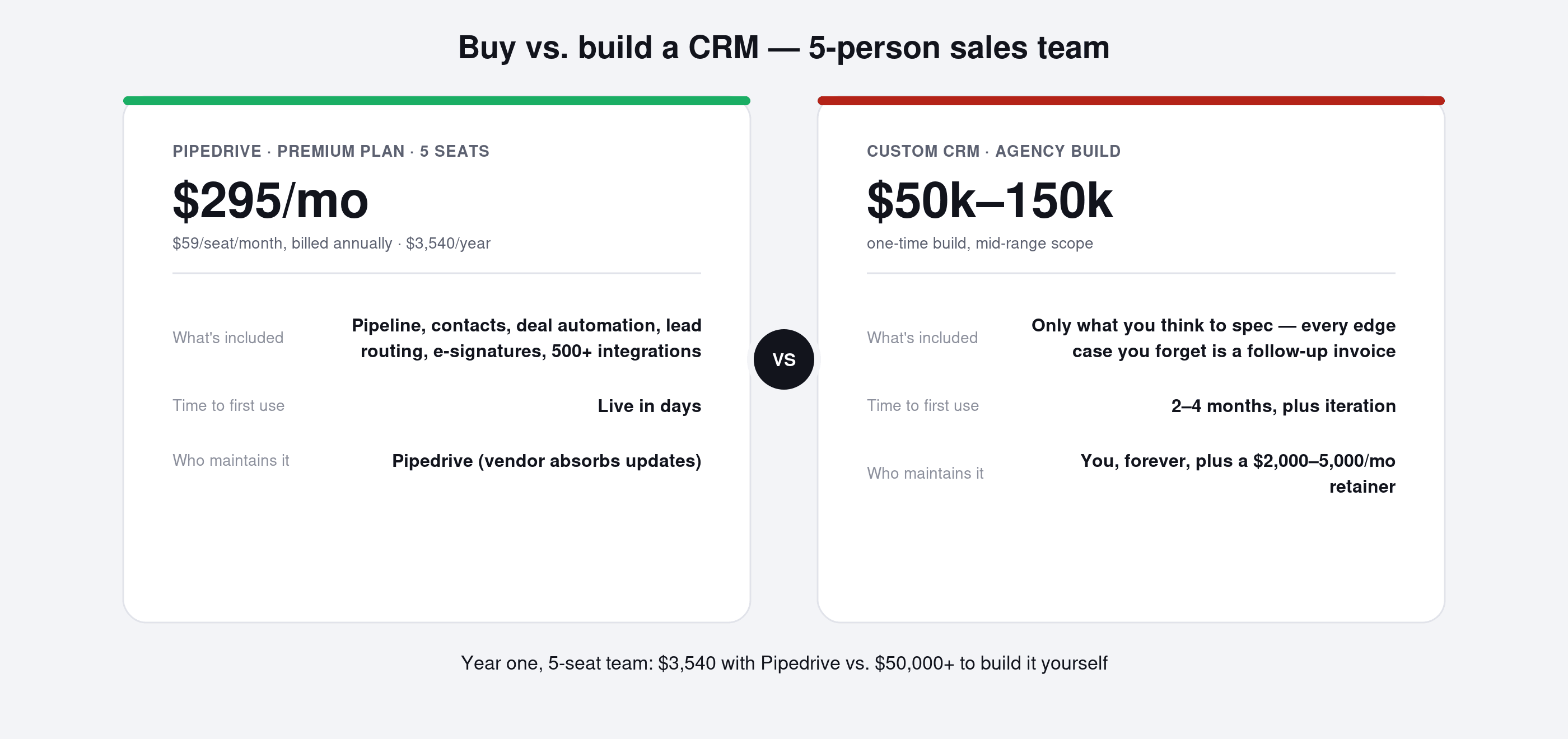
The gist:
You can explain the nuances of your business to Claude. You will fail to explain the nuances of a well-functioning CRM.
On top of that, you have to deal with hosting and security. Proper data modeling. Backend architecture. User permissions. Email and calendar integration. Debugging and QA. And rebuilding a ton of tiny features that are invisible until you miss them in your vibe-coded CRM.
| Buy a proven CRM (Pipedrive/HubSpot) | Vibe-code your own with AI | Custom build by an agency | |
|---|---|---|---|
| Upfront cost | ~€14-79/user/mo | ”Free” to generate, weeks of your time | $30K-$150K+ |
| Test group | 100,000s of users | Just you | Just you/your team |
| Maintenance + API changes | Vendor absorbs it | You, forever | You / retainer |
| Time to value | Days | Weeks of iteration | Months |
| Opportunity cost | Low, you automate instead | High | High |
CRM companies spend millions on R&D, testing, and tweaking to make their product work for tens of thousands of businesses. AI is definitely great, but it can’t cover a decade of that focused work when you tell it to build “HubSpot, but tailored for me.”
What you’ll get is a tailored pile of crap.
The hidden cost is the test group of one: a vibe-coded CRM validated by you, against a product validated by 100,000+ users across countless edge cases. Every week you spend building your own CRM is a week not spent automating cash flow and growing the business.
It’s like being late for a trade show where you sell more product, and deciding to build your own truck instead of renting one. AI can help you weld a crappy truck together in a weekend. It still won’t get you to the trade show faster than renting one and spending the weekend making more product to sell.
The right move in 2026
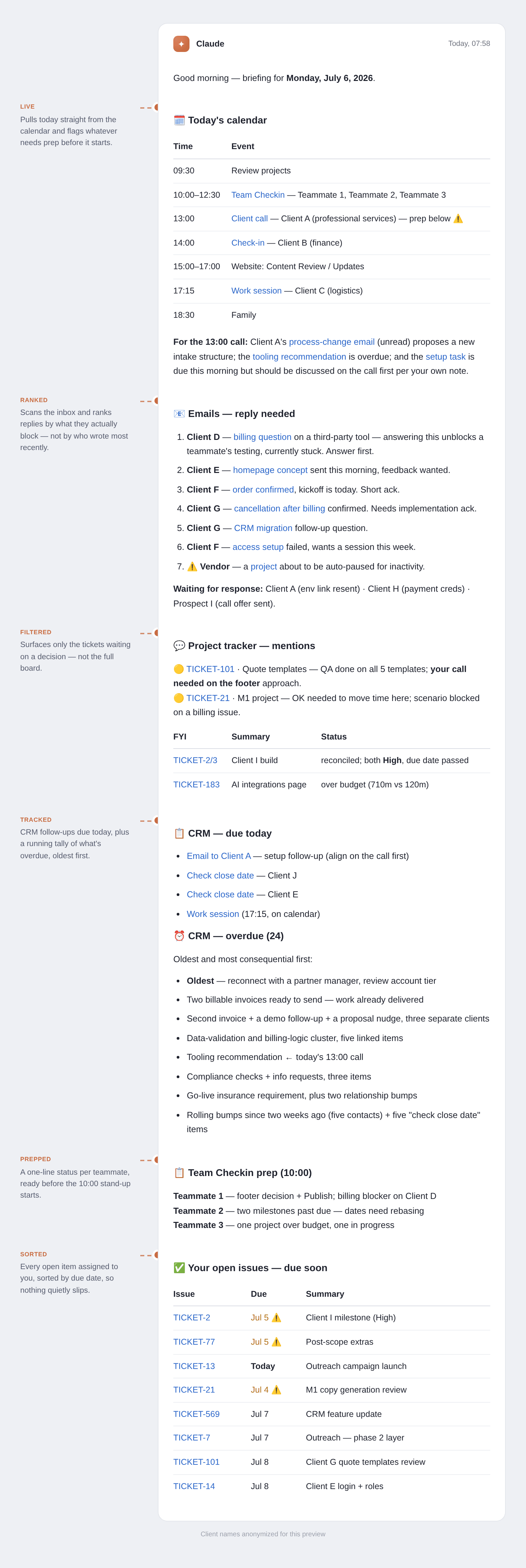
Instead of spending tokens on writing a CRM, spend them building business logic inside an existing one. Automate and simplify your workflows instead.
AI can run your agenda, generate great-looking quotes, and keep projects on track. It can flag which deals are stalling and which clients need attention while you drink your morning coffee. It can research and generate new leads. It will not grow tired of you polishing that perfect pitch.
AI is amazing as an orchestrator. Connect it to every app in your stack, let it sync data and run reports, and get back to the meaningful part of the job: making better decisions and building better services.
A simple decision
Decide what you actually want to spend your time on: learning to build a well-oiled CRM, or improving the business you’re actually in.
The truth is, it’s rarely the CRM that’s slowing you down, or the two features you feel are missing to make it “perfect” for your business. Nine times out of ten, it’s an inefficient process. Iron that out with AI instead.
As Pipedrive superfans, we’re very aware of its limitations. And boy are there plenty, especially against HubSpot’s feature set. HubSpot has its own quirks too.
That’s why we built MetaPipe and MetaHub: the MCPs we run every day at our own agency, in our own Pipedrive, and on client projects.
The official Pipedrive and HubSpot MCPs are deliberately thin. They cover a fraction of what the underlying APIs can do, and they skip the guardrails around best practice entirely. Maybe they want to avoid the Microsoft and Uber situation for their clients, I dunno.
With MetaPipe, I don’t touch Pipedrive’s UI for 90% of my work. I run 20 Claude chats in parallel, crunching through tasks simultaneously. Instead of rewriting a CRM, I tell AI what needs to be done in the one we already have. The limitations stop mattering, because it was never about the CRM. It’s about the workflow.
As a result, we move twice as fast as an agency and finish more projects than ever. Clients now do themselves what used to cost them a grand or two from us. Everybody wins.
Final note
When I started out in 2013, I had a big self-written CRM on my hands: ten years of blood, sweat, and tears. It was advanced for its time, back when neither HubSpot nor Pipedrive had figured out who they were yet.
We had subscription management, ERP functionality, web scraping, invoicing, payment reconciliation, predictive dialing. A beast even by today’s standards.
The problem: I was the brains and the head of the project, with a 30-person company acting as its only test environment.
After pitching that CRM to a few other companies, they had every right to doubt it. What if I stopped supporting it? How much would maintenance actually cost them? Could it scale with them?
I ditched the whole thing at the end. As proud as I was of it, I watched Pipedrive and HubSpot grow fast, and watched the market move first to open APIs, then to automation platforms like Make and Zapier, and now to AI and MCPs. Betting the business on one person’s code, however brilliant, was never going to beat a product tested by an industry.
That’s the same bet you’d be making by vibe-coding your own CRM today. If you want AI running your CRM instead of replacing it, talk to us: we’ll show you what’s already possible in the system you have.
FAQ
Can AI actually build a working CRM? Yes. Claude and similar tools can generate a working CRM prototype in hours. What they can’t generate is the years of edge-case handling, security hardening, and user testing that make a CRM reliable at scale.
Is it cheaper to build a CRM with AI than to buy Pipedrive or HubSpot? Absolutely not. Pipedrive and HubSpot run about €14-79 per user per month. A “free” AI-built CRM still costs you months of iteration, ongoing maintenance, and a lot of your time.
What are the hidden costs of a vibe-coded CRM? Hosting, security, data modeling, backend architecture, a bazillion features, testing and continuous debugging. All of it falls on you, forever, instead of on a vendor. It’s basically writing your own CRM like it was in 2016, but more exciting.
Should I customize Pipedrive or HubSpot instead of building my own CRM? In most cases, yes. Nine times out of ten, what feels like a missing CRM feature is actually an inefficient process. Fixing the workflow inside an existing CRM is faster and cheaper than rebuilding the CRM itself.
What is MetaPipe and MetaHub? MetaPipe and MetaHub are Metawork Studio’s own MCPs for Pipedrive and HubSpot. They give AI real, schema-checked access to your CRM, covering the guardrails and best practices the official vendor MCPs leave out.